
Mostrando postagens com marcador FMI. Mostrar todas as postagens
Mostrando postagens com marcador FMI. Mostrar todas as postagens
terça-feira, 3 de dezembro de 2013
Fora FMI!
Do portfólio do grande Henfil que a piauí publicou no mês passado. Espero que alguma editora se meta logo a fazer uma compilação bacanona da obra dele.


quinta-feira, 18 de outubro de 2012
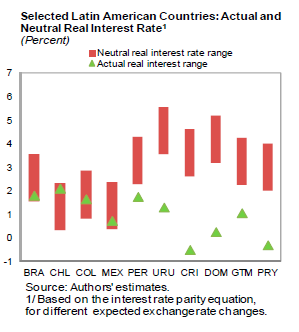
Juros reais neutros na América Latina
Um novo trabalho do FMI, dos pesquisadores Nicolas E. Magud e Evridiki Tsounta, usou sete diferentes metodologias para tentar estimar a elusiva taxa de juros real neutra para vários países da América Latina. A tabela e os gráficos abaixo resumem o que encontraram:


Interessante ver que vários dos fatores listados vêm mudando (caindo parcela de dívida indexada a Selic, tentativas de reduzir a indexação, fim do piso para os juros da poupança, aumento dos prazos dos contratos, etc).
O trabalho também fala do efeito das chamadas medidas macroprudenciais na política monetária, mas não vou me alongar mais - se você se interessa pelo assunto, vale ir direto na fonte.
Os autores também reúnem respostas para a eterna questão do juro real neutro alto para o Brasil:
While the Brazilian neutral real interest rate (NRIR) has declined considerably over time, it still remains high by international standards. Various hypotheses have been formulated for this high neutral real interest rate level:
- Fiscal considerations. Brazilian public debt, at around 65 percent of GDP in gross terms, is high by regional standards. Moreover, there is a strong endogeneity between the level of the policy rate—the SELIC—and the level of public debt, given that about half of the domestic public debt is indexed to the SELIC. This restricts the degrees of freedom for monetary policy and feeds back into a higher than otherwise SELIC, and thus NRIR (World Bank, 2006). Similarly, Rogoff (2005) argues that Brazil incurs a significant default risk premium due to its inflationary history; an argument reinforced empirically by World Bank (2006).
- Low domestic savings. Brazil’s low domestic savings, and thus investment, is also cited as a reason for a higher NRIR (Fraga, 2005; Miranda and Muinhos; 2003; Hausmann, 2008; and Segura, 2012). However, Segura (2012) finds that low domestic savings cannot adequately explain the cross-country discrepancy.
- Institutional factors. Weak creditor rights and contractual enforcement have been cited as possible explanations for a higher NRIR (Arida et al., 2004; Rogoff, 2005). Lack of full central bank independence is also used to explain the high NRIR, though Nahon and Meuer (2009) find no changes in central bank’s credibility due to recent changes in its Board of Directors.
- Widespread financial indexation. There is strong inertia due to the indexation of financial contracts to the overnight interest rate (World Bank, 2006). While this indexation has maintained financial intermediation in Reais, it has created a system of unusually short duration financial contracts. The legacy of indexation to the overnight interest rate has created institutional and psychological inertia, and a path-dependency that has been difficult to dislodge. It has also made inflation less responsive to interest rate changes.
- Other Brazil-specific factors. Subsidized lending has resulted in credit market segmentation, pushing up market-determined interest rates. Other factors that might keep the nominal neutral interest rate high include an inflation target that is higher than in other emerging market economies and the minimum remuneration requirements in saving accounts (see Segura (2012) and Central Bank of Brazil (2012) for details).
Interessante ver que vários dos fatores listados vêm mudando (caindo parcela de dívida indexada a Selic, tentativas de reduzir a indexação, fim do piso para os juros da poupança, aumento dos prazos dos contratos, etc).
O trabalho também fala do efeito das chamadas medidas macroprudenciais na política monetária, mas não vou me alongar mais - se você se interessa pelo assunto, vale ir direto na fonte.
quinta-feira, 11 de outubro de 2012
Leituras da Semana
- Fabio Giambiagi sobre o impacto da queda dos juros nos fundos de pensão brasileiros.
- Olivier Blanchard sobre o multiplicador fiscal.
- Um ótimo trabalho do Banco da Inglaterra defendendo mais simplicidade na regulação bancária, fortemente inspirado nas ideias do psicólogo alemão Gerd Gigerenzer.
- Aritmética simples aplicada a preços pode ser muito cruel.
- Um paper sobre o aumento do uso de equações e ferramentas econométricas nos trabalhos de economia. Essa figura é de lá (via Justin Wolfers):

- A última edição da Foreign Policy, sobre economia global, está muito boa: quem ganhou na Grande Recessão, repensando os BRICS e alguns pensamentos de Nassim Taleb.
- Noah Smith divaga sobre as consequências de blogar sobre economia.
- A relação (ou não) entre centros financeiros e centros de arte.
- A Suécia leva a sério essa história de igualidade.
- Ótimo texto sobre parte da geração que chega agora aos 20 e alguns anos, seu egocentrismo e problemas em lidar com o mundo fora da faculdade (acho que em larga medida vale também para a minha geração, dos 30 e poucos). Dica: Marcio Guilherme.
- Small Demons, um site que lista referências culturais em livros e vai te tomar muitas e muitas horas.
- Olivier Blanchard sobre o multiplicador fiscal.
- Um ótimo trabalho do Banco da Inglaterra defendendo mais simplicidade na regulação bancária, fortemente inspirado nas ideias do psicólogo alemão Gerd Gigerenzer.
- Aritmética simples aplicada a preços pode ser muito cruel.
- Um paper sobre o aumento do uso de equações e ferramentas econométricas nos trabalhos de economia. Essa figura é de lá (via Justin Wolfers):
- A última edição da Foreign Policy, sobre economia global, está muito boa: quem ganhou na Grande Recessão, repensando os BRICS e alguns pensamentos de Nassim Taleb.
- Noah Smith divaga sobre as consequências de blogar sobre economia.
- A relação (ou não) entre centros financeiros e centros de arte.
- A Suécia leva a sério essa história de igualidade.
- Ótimo texto sobre parte da geração que chega agora aos 20 e alguns anos, seu egocentrismo e problemas em lidar com o mundo fora da faculdade (acho que em larga medida vale também para a minha geração, dos 30 e poucos). Dica: Marcio Guilherme.
- Small Demons, um site que lista referências culturais em livros e vai te tomar muitas e muitas horas.
domingo, 27 de maio de 2012
O dia de fúria de Lagarde

Asked whether she is able to block out of her mind the mothers unable to get access to midwives or patients unable to obtain life-saving drugs, Lagarde replies: "I think more of the little kids from a school in a little village in Niger who get teaching two hours a day, sharing one chair for three of them, and who are very keen to get an education. I have them in my mind all the time. Because I think they need even more help than the people in Athens."
Lagarde, predicting that the debt crisis has yet to run its course, adds: "Do you know what? As far as Athens is concerned, I also think about all those people who are trying to escape tax all the time. All these people in Greece who are trying to escape tax." She says she thinks "equally" about Greeks deprived of public services and Greek citizens not paying their tax.
"I think they should also help themselves collectively." Asked how, she replies: "By all paying their tax."
Asked if she is essentially saying to the Greeks and others in Europe that they have had a nice time and it is now payback time, she responds: "That's right."
(...)
In her interview Lagarde says Greece is not getting softer treatment than a poor country in the developing world, and that the IMF does not find it harder to impose strong conditions on a rich nation.
"No, it's not harder. No. Because it's the mission of the fund, and it's my job to say the truth, whoever it is across the table. And I tell you something: it's sometimes harder to tell the government of low-income countries, where people live on $3,000, $4,000 or $5,000 per capita per year, to actually strengthen the budget and reduce the deficit. Because I know what it means in terms of welfare programmes and support for the poor. It has much bigger ramifications."
Talvez tenha faltado algum tato na escolha das palavras e medida do impacto desse tipo de declaração (além, claro, dos problemas com a generalização dos hábitos tributários da população de um país inteiro). Mesmo pesando isso, acho que é exatamente esse tipo de postura que falta em políticos quando se discute a crise: essa é linguagem para adultos, sem dissimulação ou promessas impossíveis de serem cumpridas. O FMI está longe de ser uma entidade filantrópica, representa interesses e defende uma certa visão de política econômica. Que os eleitores envolvidos informem-se e tomem a decisão que julgarem mais adequada, pesando as consequências associadas. Declarações desse tipo ajudam nessa tarefa, mas tem sido tão raras que devem ser celebradas. Bien fait, madame Lagarde.
A última pergunta da entrevista foi menos destacada, mas também merece registro:
I try once more. When history books are written about the financial crisis, they will say it began in 2008. What date will they give for its end? "Hmm, after the hyphen? After 2008? Two thousand," she says firmly. How odd, I think – her English is perfect, but she must have misunderstood the question. I ask again, but she is laughing. There was no misunderstanding.
"Well, I'm sure about the first two digits: 20. But I'm not sure about the last two digits."
Assinar:
Postagens (Atom)


